

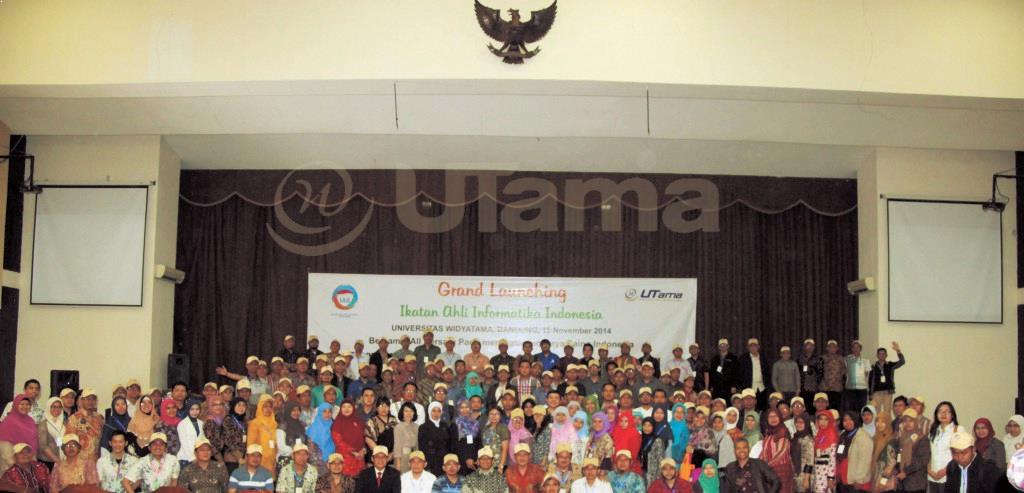
Nowadays, information can be accessed anywhere and anytime. People no longer need a sophisticated computer or laptop to access events around the world; they can do so with just their mobile devices. All of this is inseparable from the increasingly advanced and sophisticated development of information technology.
Indonesia, with a population that currently stands at nearly 350 million people and is dominated by productive-age citizens, has tremendous potential to become one of the world’s economic powers. Unfortunately, of this number, each year, the number of new Information Technology (IT) graduates in Indonesia only reaches 300,000 people per year, coming from 250 study programs at universities throughout Indonesia. This large number does not guarantee that most IT alumni will continue to develop their skills in the IT field. Many alumni are actually working in non-IT fields, and quite a few are working abroad. Meanwhile, Indonesia needs 500,000 IT graduates every year in order to catch up in the IT field.
On the other hand, we are also faced with the government’s desire to implement e-government in all lines. All activities that use paper and wet stamps will be replaced by e-documents. Of course, this requires careful planning and development of infrastructure and information systems to reach all ministries and local governments on 17,000 islands throughout Indonesia. Information technology offers a wide variety of professions. IT graduates can work as programmers, operators, technical support, system administrators, database analysts, etc. Unfortunately, currently all institutions set different technical and experience requirements for each of these professions. In addition, each university also has a different curriculum reference that is taught at its institution. As a result, IT graduates in Indonesia have a very diverse knowledge base and are not necessarily ready to immediately work in the industrial world. Meanwhile, companies that employ IT graduates expect that the IT graduates they recruit will be able to solve various problems within the company. The unpreparedness of IT graduates and their lack of experience result in the low quality of work produced by IT graduates, which in turn reduces the industry’s confidence in the quality of IT graduates in Indonesia. This condition can be addressed by implementing professional certification for IT graduates. Companies that intend to develop the quality of their IT human resources can enroll their IT personnel in this training and certification program. Unfortunately, many of the available certification processes are affiliated with specific products and technologies, and companies need to spend a considerable amount of money to pay for the training and certification fees. On the other hand, IT graduates who do not have the necessary skills and certification are forced to accept inadequate wages.