
Guided by a moderator who is a lecturer at Widyatama University, Dr. Diana Sari, S.E., M.Si., Ak., QIA., C.A., the Mudzakarah began with a simulation, or rather an information session, from officials at the Bandung City Center SAMSAT. The event continued with a Mudzakarah moderated by Mr. Mahfud MD.
The discussion of the ICMI Expert Council Mudzakarah focused more on “State Constitutional Arrangements.” In addition, the discussion touched on the polemic between the Indonesian National Police (POLRI) and the Corruption Eradication Commission (KPK). The polemic between the KPK and POLRI has intensified following the arrest of Bambang Widjojanto (BW). So, who is behind the turmoil between these two law enforcement agencies?
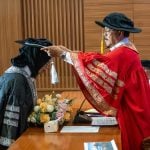
ICMI Expert Council Mudzakarah with Prof. Dr. Mohammad Mahfud M.D., S.H., S.U. Bandung (23/2/2015), Widyatama University welcomed a guest. The guest was the former Chief Justice of the Constitutional Court of the Republic of Indonesia for the 2009-2014 term, Prof. Dr. Mohammad Mahfud M.D., S.H., S.U. The event, which was held at the Widyatama University GSG, was also attended by representatives of the Governor of West Java and several Bandung City officials. With an audience of Master of Accounting (MAKSI) and Master of Management (MM) students, the public lecture proceeded with solemnity. Guided by the moderator, who is a lecturer at Widyatama University, Dr. Diana Sari, S.E., M.Si., Ak., QIA., C.A., the discussion began with a simulation, or rather an information session, from officials of the Bandung City Center SAMSAT. The event continued with a discussion moderated by Mr. Mahfud MD. The discussion of the ICMI Expert Council Mudzakarah focused more on “State Constitutional Arrangements.” In addition, the discussion touched on the polemic between the Indonesian National Police (POLRI) and the Corruption Eradication Commission (KPK). The polemic between the KPK and POLRI has intensified after the arrest of Bambang Widjojanto (BW). So, who is behind the turmoil between these two law enforcement agencies?
Reconciling the Indonesian National Police and the Corruption Eradication Commission Although some people try to sugarcoat the situation and say that there is no conflict between the Corruption Eradication Commission and the Indonesian National Police, but only issues involving individuals or dynamics, public common sense dictates that there is indeed conflict and turmoil between the two institutions. Therefore, serious steps must be taken to reconcile them. Why must they be reconciled? The police must exist as a representation of state power in the fields of security and law enforcement. The KPK, as a product of reform, must exist in accordance with its founding purpose to strengthen the eradication of corruption. Our POLRI is not only concerned with corruption but also with much broader issues that are very important for the continuity of the state, namely order, security, and public peace. Imagine if the state had no effective police force. In its general duties, the National Police is quite professional. For example, in handling terrorism, kidnapping, mutilation, drugs, and so on. If there are issues of corruption in the National Police, they should be viewed as normal cases, just like in other institutions. In the field, there are many members of the National Police who are clean, dedicated, and patriotic. Therefore, the Indonesian National Police and the Corruption Eradication Commission (KPK) must work in synergy, not in rivalry. It is hoped that with this event, the public will become more “aware” of the current state of the nation. The function of the state in establishing an institution for human rights and a law enforcement agency requires a peaceful relationship between them. This is so that there is no point of intervention between party A or party B.