
With the advent of competition in 2015, the ASEAN Economic Community (AEC) has created problems for private universities. The government wants graduates who are highly qualified in the ASEAN economy. The government has not once measured this policy with the synergy of technology and science obtained by the country.
Responding to the policy of President and Vice President Jokowi and Jusuf Kalla, the Directorate General of Higher Education, which was originally under the Ministry of Education and Culture, is now under the Ministry of Industry, Technology, and Higher Education.
There are many issues related to the future of private universities (PTS). Initially, there was news that Kopertis would be dissolved and transformed. The moratorium on the establishment of new PTS has been lifted, and there are issues with the Foundation Law that prohibits advisors from receiving salaries or honoraria, as well as many other issues.
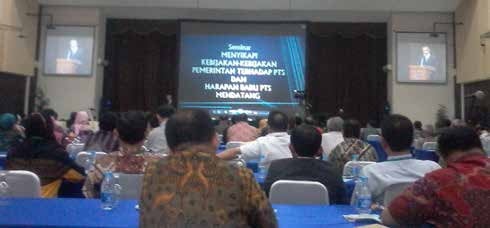
Therefore, the West Java and Banten Regional Association of Indonesian Private Higher Education Institutions (BP PTSI) held a seminar with the theme, “Responding to Government Policies on PTS and New Hopes for PTS in the Future.”
The event invited the Chair and Vice Chair of APTISI West Java and Banten, Kopertis Region IV, and seminar participants consisting of foundation members and PTS leadership from West Java and Banten. At exactly 9:00 AM, the seminar opened with the singing of the Indonesian national anthem to honor the seminar proceedings.
The opening remarks from the Chair of Aptisi West Java Banten were followed by remarks from the Chair of the Widyatama University Foundation, T. Ontowiryo, S.E., MBA. In his interview, the Chair of Aptisi West Java explained the government’s attention release in improving the quality and performance of private universities. “Regulations given to private universities in terms of appointing rectors and vice rectors should be mandated to the senate and foundation, not the minister’s authority to give job mandates. Because the chairperson of the foundation is equivalent to a minister,” said the chairperson of Aptisi West Java in his interview with the press.
With the competition in 2015, the ASEAN Economic Community (AEC), and the current problems in private universities, the government wants graduates who are highly qualified in the ASEAN Economic Community. The government does not measure this policy solely with the synergy of technology and science obtained by the country.
The hope from Dikti itself, with the many government policies, is that the Foundation and the Rectorate must synergize well, so that there is more open sharing when there are new policies, thereby ensuring good transparency, said the Deputy Chairperson of Aptisi Central.