
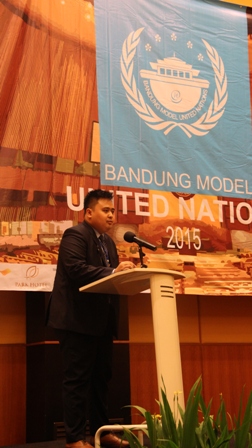
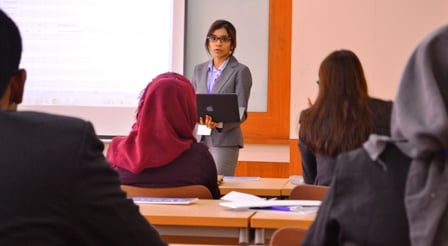
A total of 94 students from five countries competed in a debate on global issues at Widyatama University, Bandung last week. The five countries were Indonesia, Singapore, the Philippines, India, and Turkey. They conducted a simulation of a UN session discussing world issues such as global oil, ISIS, the Syrian crisis, the European economic crisis, and the 2015 ASEAN Economic Community.
Widyatama University Rector Islahuzzaman said that the event, titled Bandung Model United Nations 2015, honed the students’ courage to speak at the international level. It allowed them to share their ideas, actualize themselves, hone their critical and logical thinking skills, and more. “Another benefit is that students can expand their network. Not only in Bandung, West Java, Indonesia, but also at a broader level, namely the international level,” said Islahuzzaman when met in his office last week.
He hopes that this debate event can shape students to be competitive, critical, creative, and have good character. It can also hone students’ skills in debate and public speaking. “Debating is one way to train courage and self-actualization so that students can become part of the solution to national problems,” he continued.
Through this activity, he said, students can convey their ideas and opinions on current important issues. They can even propose solutions to various national problems at the international level.
When met at the event location, the General Secretary of Bandung Model United Nations 2015, Galih Wahyu, explained that the outcome of this activity would be recommendations summarized from the participants’ ideas. After the three-day event (April 17-19), these recommendations would be submitted to the relevant parties.
“The topics discussed are very important. For example, the case of Syria, which we know is the bloodiest civil war statistically. Then there is the rampant problem of ISIS. The same goes for other topics,” he said. He emphasized that this debate activity focuses on interpersonal diplomacy, not on political power that pits voices against each other, but rather emphasizes a common perception.