
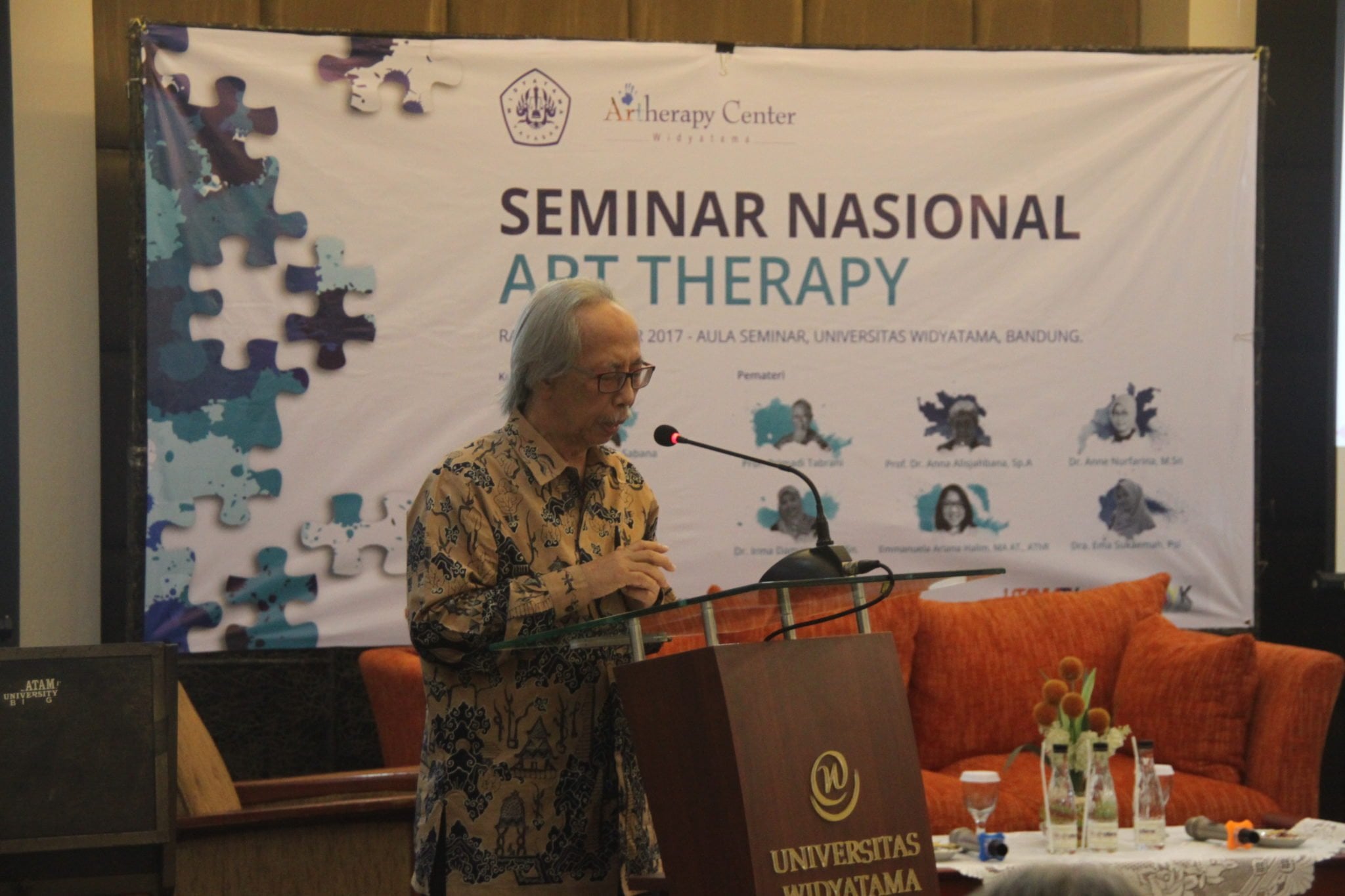
Wednesday (6/12) Widyatama Art Therapy Center held a National Seminar in the Seminar Room on the 6th floor of Building B at Widyatama University. At exactly 9:00 a.m., the event was opened with remarks from the chief organizer, Gena Diniarti, M.Pd, the chair of the Art Therapy Center, Dr. Anne Nurfarina, M.Sn, and the chair of the Widyatama Foundation Management Board, Sri Lestari, S.H. The event consisted of a one-day seminar divided into two sessions. The first session discussed “human creativity” with Prof. Primadi Tabrani as the guest speaker, “Art Psychology” by Prof. Dr. Setiawan Sabana, MFA, and “Sensory Methods” by Dr. Anne Nurfarina, who is also the chairperson of the Widyatama Art Therapy Center.
Next, the second session discussed “Assessment of children with special needs at an early age” with Prof. Dr. Anna Alisyahbana, Sp.A as the speaker, “Psychology of children with special needs” by Dra Ema Sukaemah, Psi, and “Art Therapists” by Emmanuela Ariana Halim, MA AT, AThR. Both sessions will conclude with the reading of the discussion results in the form of an agreement on the definition of Art Therapy, the principles of Art Therapy, and the Art Therapy system.
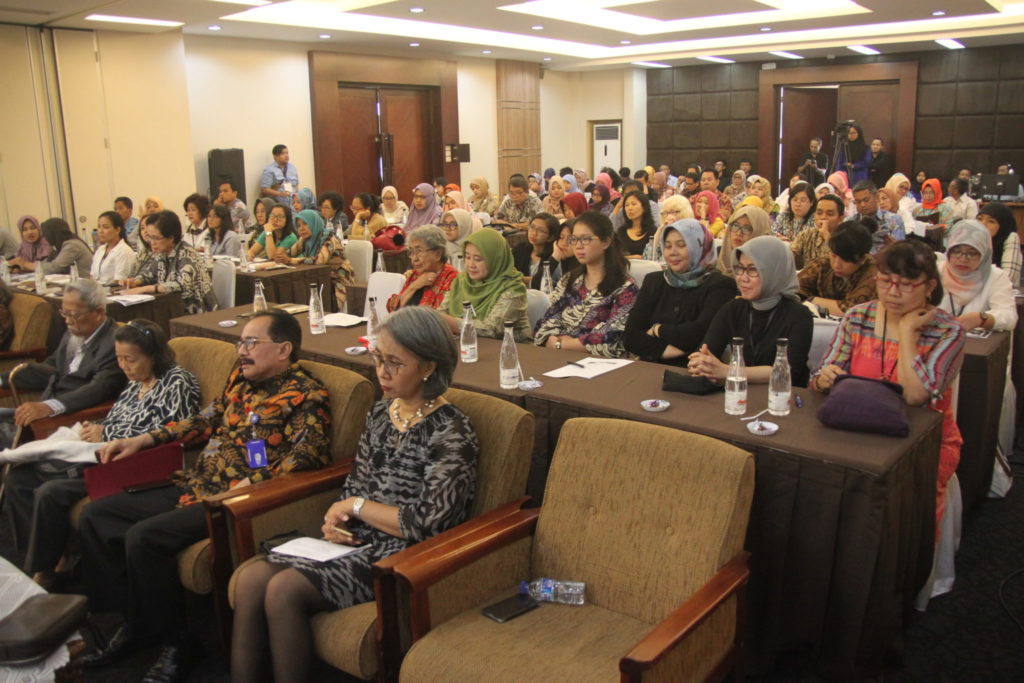
Almost 100 participants attended this seminar, consisting of special needs teachers, inclusive school teachers, Widyatama University students, parents of children with special needs, therapists, and the general public. Through this National Seminar, it is hoped that a definition, rules, and implementation system for Art Therapy can be obtained to build basic behaviour as well as the talents and potential of students with special needs.
Art Therapy is an alternative therapy that can help children with special needs who experience developmental obstacles. These developmental obstacles include physical, emotional, mental, and behavioral development. This therapy is designed to optimize the strengths and uniqueness of each child. Several studies have shown that art therapy can improve motor skills, increase concentration/focus, and stabilize emotions. This is especially true if the therapy is conducted in an environment that makes children feel relaxed and safe. (Suzie Dalien, 2014)