

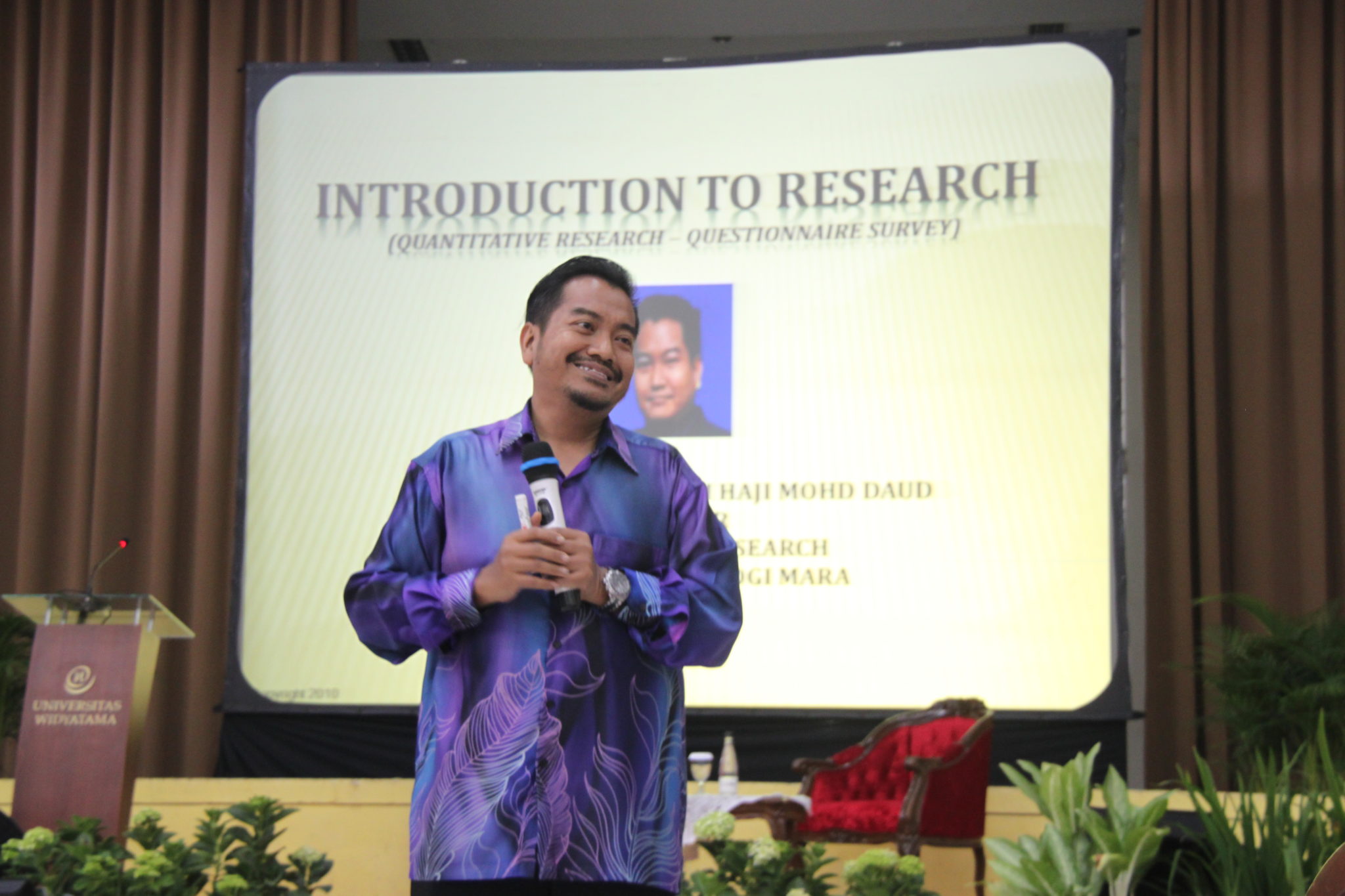
To improve the quality of research conducted by lecturers at Widyatama University in line with the expectations of the Ministry of Research, Technology and Higher Education, particularly in terms of Scopus indexing, it is necessary to hold a workshop led by Q1 Scopus-level reviewers so that lecturers can conduct high-quality research to improve the standing of Widyatama University.
This was conveyed by the Vice Rector for Academic Affairs, Planning and Cooperation at Widyatama University, Prof. Mohd. Haizam Bin Mohd. Saudi, during his opening speech at the “Research Development Workshop” organized by the Foundation Leadership and Rectorate of Widyama University at the Widyatama Auditorium (GSG) on Tuesday-Wednesday, September 18-19, 2018. The workshop was led by Q1 Scopus Reviewer from Universiti Teknologi Mara (UITM) Malaysia, Professor Dr. Norzaidi Haji Mohd Daud, and attended by lecturers from Widyatama University.
According to Prof. Dr. Norzaidi, currently many researchers still use qualitative and quantitative types of research, but the correct and popular types in Malaysia are three types of research, namely basic research, applied research, and translational research. To distinguish between these three types of research, Prof. Dr. Norzaidi used a simple sample in the form of a ballpoint pen. In the past, there were no ballpoint pens, but now there are ballpoint pens, and that is basic research. Once ballpoint pens exist, improving them by changing the color from blue to red is applied research. Findings or research that are already available and implemented for the benefit of society are called translational research.
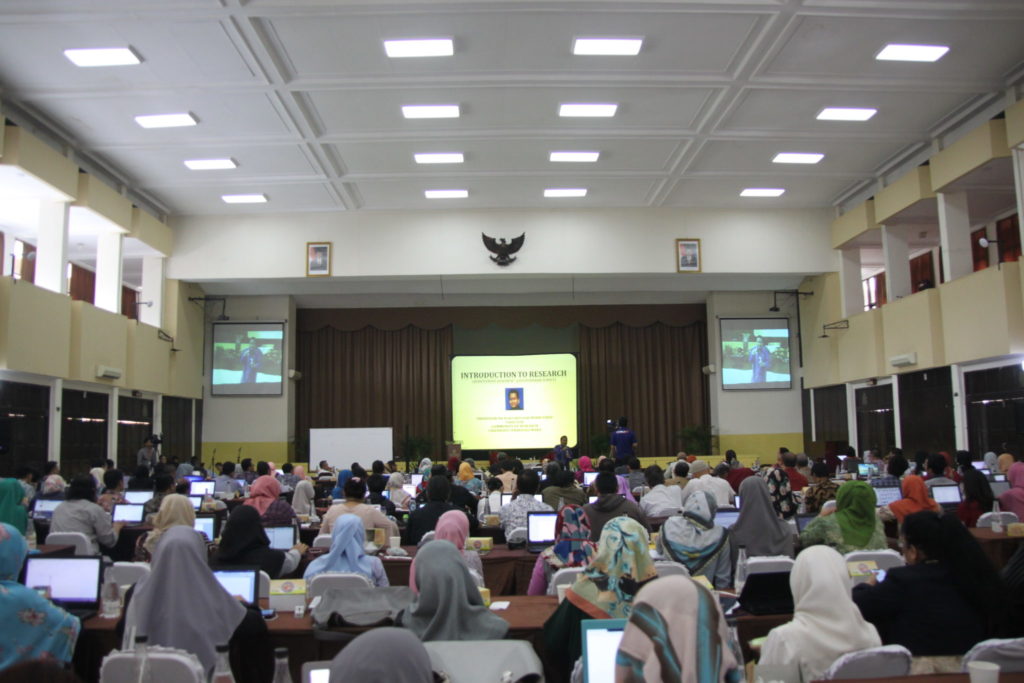
Lecturers at Widyatama University participated in a Research Development Workshop.
What researchers must do, but not about methodology, are the following five approaches: (1) core area research approach; (2) collaborative research approach; (3) student research approach; (4) Angel research approach; and (5) pipeline research approach. He emphasized: “First and foremost, I will explain the first approach, which is the ‘Niche’ research approach. This approach requires researchers to concentrate and determine their field of research, for example, from their Ph.D. work. By utilizing this approach, researchers can gain several advantages, including: it will be easier to be accepted because researchers gain recognition through increased research and writing in a specific field, which ultimately builds their reputation as experts in the niche field.”
Kedua, dianggap penting untuk mengejar penelitian kolaboratif di mana penelitian akademis dibagi di antara para peneliti. Dengan demikian, lanjutnya, mengatakan “Akan ada banyak keuntungan untuk mendapatkan seperti pekerjaan yang dikumpulkan, penelitian dan penulisan dapat ditingkatkan melalui penelitian kolaboratif untuk meningkatkan produktivitas dan tingkat penerimaan proposal penelitian dan juga untuk meningkatkan komitmen untuk menyelesaikan tugas khusus yang disepakati dari proyek penelitian.”
Ketiga, juga penting untuk mempertimbangkan pendekatan Research student agar selalu membawa ide baru, belajar dari orang lain dan mensinergikan gagasan baru mengingat kompleksitas isu terkini. “Pendekatan ini dapat diadopsi untuk mencari hubungan komplementer – sinergi yang dikelola dan dirancang untuk mempromosikan ide-ide baru dan oleh karena itu kegiatan tersebut tentu dapat mengarah pada perluasan cakupan penelitian dan juga kaitannya dengan pendanaan penelitian,” tambah Prof. Dr. Norzaidi.
Saat melakukan penelitian, tidak hanya perspektif peneliti yang penting, namun sudut pandang dari lembaga pendanaan juga perlu diperhitungkan. Pendekatan semacam itu mungkin bisa diterapkan karena jaringan (akademisi dan non-akademisi), konferensi atau pertemuan bisnis, strategi dan publikasi strategi kontrak menang-menang. Ini adalah pendekatan keempat yang bisa diimplementasikan, menurut Prof. Dr. Norzaidi. Sedangkan pendekatan terakhir adalah pendekatan penelitian pipeline yang mengharuskan pembangunan pertama massa kritis setidaknya dua proyek penelitian yang siap diajukan. Sebagai konsekuensinya, Prof. Dr. Norzaidi menyoroti, mengatakan: “Begitu kita mengembangkan sebuah massa kritis kita perlu mempertahankannya dengan menyiapkan proposal baru untuk ditambahkan ke tumpukan proposal yang diajukan, sementara yang lain diterima”. (Ed)