
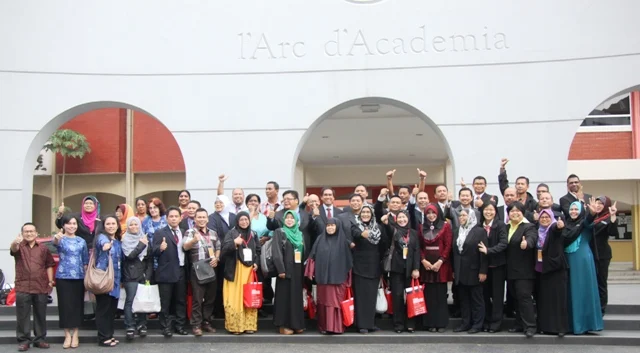
Bandung (March 16, 2015), Widyatama University in collaboration with Selangor University Malaysia (Unisel) held an International Seminar with the theme “Toward Increase of Human Quality Standard for Asean Economic Community in 2015” Malaysia-Indonesia International Postgraduate Social, Economic, Science, and Education Research Seminar 2015. Attended by several participants such as Batanghari University Jambi, Indonesian College of Economics, and Mandala Institute. The seminar raised issues that are currently hot topics in the world of education, especially in Asian countries. The issue of human resource qualifications possessed by countries must be aligned with the curriculum and the needs of companies in recruiting employees. Facing the ASEAN Economic Community, or what we commonly refer to as the ASEAN Economic Community (AEC), university graduates must have added value so that they are globally competitive.
The seminar was attended by the Rector of Widyatama University and his staff, the Chair of the Widyatama Foundation, and guests from Unisel and several other universities. Beginning with the opening, the event continued with presentations and discussions by the Rector of Widyatama University, Dr. H. Islahuzzaman, S.E., M.Si., Ak., C.A., and Dr. AzaAzlina Md. Kassim as representatives from the University of Slangor, as well as Prof. Dr. Davidescu Cristiana Victoria M, M.A.
Social aspects, science and technology, economics, business, and knowledge insights are the focus areas for improving the human resources of university graduates in the Asian region so that they can compete with graduates from universities around the world.
“With high-quality human resources, there will definitely be a very short waiting period for graduates. The faster the absorption of graduates, the better the education system in that institution,” said Dr. H. Islahuzzaman, S.E., M.Si., Ak., C.A. in his presentation.
The presence of the ASEAN Economic Community can help ASEAN countries overcome their powerlessness in global economic competition by forming a single market based in the Southeast Asian region. Liberalization in the service sector related to human resources may be clearly visible because it concerns the placement of skilled and unskilled workers in supporting the country’s economy. However, skilled labor has the most influence and is highly emphasized in the ASEAN Economic Community.
To facilitate the liberalization of services and ease the mobilization of professional labor across ASEAN countries, it is necessary to have an agreement on the recognition of professionals in the service sector, which is manifested in a memorandum of mutual recognition. The task of the government and related stakeholders is to prepare superior and competitive human resources by ensuring economic development with human development. High-quality labor will be present if the quality of human development in Indonesia is competitively superior.
A total of 110 lecturers from each participating university presented material related to the 2015 ASEAN Economic Community. This presentation process also supports lecturers in advancing their functional positions at their home universities. With the holding of this international seminar, there will be discussions about Widyatama University collaborating with three other Asian countries in organizing the next seminar.