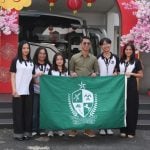
The cyber test for the Joint Entrance Examination for Private Universities (UMB PTS) period 2, on Sunday, February 21, 2010, was held at the Widyatama University campus in Bandung and simultaneously implemented at 33 private universities throughout Indonesia. UMB PTS is an efficient alternative for prospective students who wish to enter private universities while saving time, energy, and costs. With a single payment of Rp. 225,000 and a single exam, prospective participants can directly choose 4 study programs at 4 PTS that have joined UMB PTS. The reasons for efficiency in terms of time, cost, and effort are generally the considerations for prospective students to take the UMB PTS. Test participants are also given the convenience and flexibility to choose the test location at the PTS closest to their residence. Test participants do not need to take the test at the location of the study program or university of their choice. Test participants can choose any study program.
The exam uses a computerized system or cyber test, meaning that examinees take the exam directly online in the laboratory at the PTS of their choice. The city of Bandung is represented by three major PTS: Widyatama University Bandung, Parahyangan University, and ITENAS. Meanwhile, exam participants are divided into two groups: those who take the Natural Sciences (IPA) exam and those who take the Social Sciences (IPS) exam. Each participant can choose to take either the IPA or IPS exam, regardless of their high school major.
Therefore, participants who majored in natural sciences in high school can choose either the natural sciences group or the social sciences group, and vice versa. These groups only depend on the study programs that participants can choose. Participants in the natural sciences group can only choose study programs in the natural sciences group, and participants in the social sciences group can only choose study programs in the social sciences group. The exam material consists of basic skills in the form of mathematics, Indonesian language, and English language questions. For science skills, the questions cover biology, chemistry, physics, and integrated science. For social studies skills, the questions cover history, geography, economics, and integrated social studies.