
The progress of the implementation of the Merdeka Belajar Kampus Merdeka (MB-KM) program at Universitas Widyatama (UTama), which has been running since the even semester of the 2020-2021 academic year, has attracted the attention of LLDIKTI.
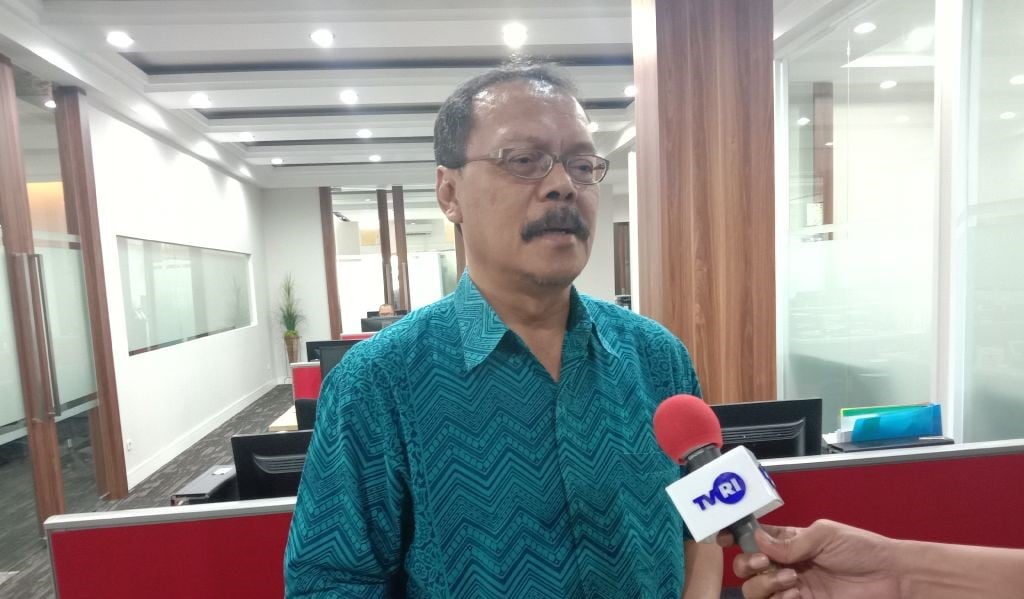
“Yes, we received this information from the LP2M Widyatama University after they were contacted by LLDIKTI, so that the implementation of MB-KM UTama could be exposed,” said Prof. Dr. H. Dadang Suganda, M.Hum., Vice Rector for Academic, Student Affairs and Learning at UTama, Saturday (24/7/2021).
“What has been implemented in the academic process (MB-KM) includes UTama relaxing the curriculum. Five semesters are for program study competencies and three semesters are for additional competencies. In those three semesters, our students study one semester outside their study program and two semesters outside the campus,” he added.
Prof. Dadang further stated that during the implementation of MB-KM, UTama students have undertaken internships at companies, engaged in entrepreneurship, participated in village development programs, humanitarian activities, joint research with lecturers, and other activities. These activities will be recognized and counted as credit hours to fulfill the total credit hours required to obtain a bachelor’s degree.
“The results of internships, entrepreneurship, and village development activities can be used as final assignments. Ideally, they should be made into systematic reports. In addition, they can be used as accredited journal articles,” said Prof. Dadang.
The benefits of two semesters outside the campus for students include gaining direct work experience in the real world. This includes acquiring linear knowledge in accordance with the curriculum, including new developments.
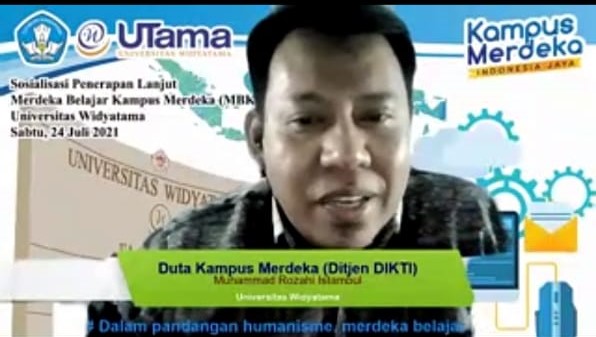
Dr. M. Rozahi Istambul, S.Kom., M.T., Ambassador of Kampus Merdeka Universitas Widyatama
“Every study program at Widyatama University has actually been advised to implement MB-KM, but the most aggressive implementation is still being carried out by the Faculty of Engineering,” said Prof. Dadang.
To implement and accelerate this program in the future, Widyatama University has assigned Dr. Muhammad Rozahi Istambul, Dean of the Faculty of Engineering, who was also elected as the Ambassador of Kampus Merdeka Universitas Widyatama.
“Mr. Rozahi is tasked with accelerating, facilitating, and providing knowledge related to the implementation of MB-KM at Universitas Widyatama. Especially how to define it operationally,“ said Prof. Dadang.
”Actually, there are still many universities that have not implemented MB-KM, including understanding it. Alhamdulillah, Universitas Widyatama has been able to do so. We have been able to design MB-KM outputs, which will later become comprehensive activities in each study program. In principle, we have actually implemented the kampus merdeka,” he concluded.
On a different occasion, Dr. Muhammad Rozahi Istambul said that he was appointed by the Director General of Higher Education to be the Ambassador Kampus Merdeka, continuously providing information about MB-KM. Not only for the UTama campus, but also for other campuses.
During his appearance as a speaker at the webinar “Socialization of the Acceleration of MB-KM at Universitas Widyatama” on Saturday (July 24th, 2021), he emphasized that in developing MB-KM, the focus must be on students. Every study program must truly facilitate students who wish to participate in the MB-KM program.
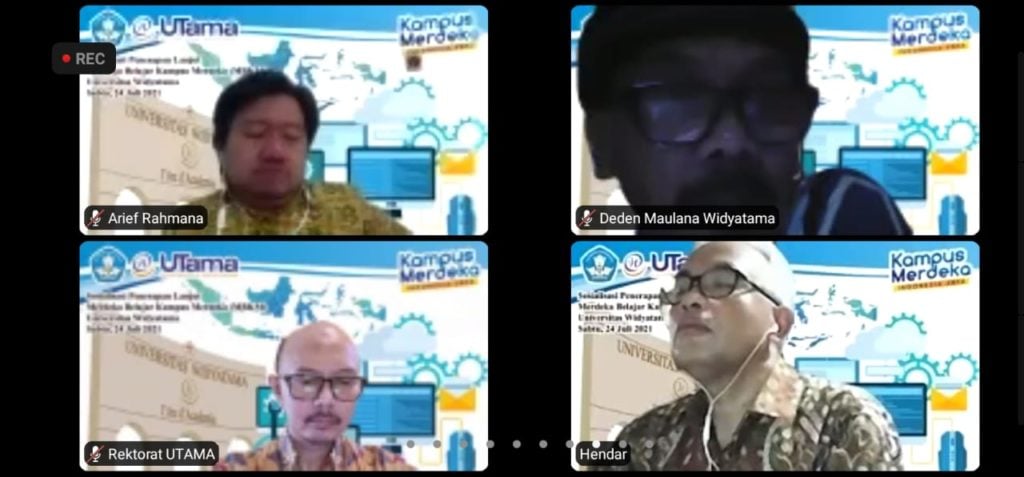
Students can participate in MB-KM in accordance with the government’s nine main indicators, such as student exchanges, internships/work placements, teaching assistance in educational units, research, humanitarian projects, entrepreneurial activities, independent studies/projects, and village development/thematic fieldwork.
However, he does not deny that currently there are several study programs and lecturers who are skeptical about the implementation of the MB-KM program, worrying that it will reduce the scientific competence of students during their studies on campus.
Dr. Rozahi added that students can participate in MB-KM linearly according to their field of study or across disciplines. This is to provide freedom, independence, and develop the competence of students outside their field of study. While on campus, students receive academic knowledge in their respective fields (five semesters), and for the remaining three semesters, they are given the freedom to develop themselves according to their interests and outside their academic fields.
The MB-KM program itself is carried out over three semesters, which can be taken in the sixth, seventh, and eighth semesters. Two semesters are spent off campus, and one semester is spent on campus (outside the study program).
“If totaled, it amounts to 60 credits. But it is not mandatory; it is up to the relevant study program whether to participate. If not, that’s fine, and there are no penalties. However, it is unfortunate if we do not facilitate our students to understand the characteristics of the outside world, as their passion may not fully align with their study program,” said Dr. Rozahi.
“It turns out that internships at other places are more interesting. For example, it is perfectly acceptable for engineering students to do internships at political parties. This provides insight, so that after graduating, they can join political parties and implement engineering values, as well as knowledge and other fields,” he added.
The government also gives universities the freedom to develop MB-KM. So, according to Dr. Rozahi, universities are given full authority through the rectorate to plan their MB-KM.
At UTama itself, Dr. Rozahi said that each study program is given the freedom to design MB-KM.
“So, it is indeed good to be given complete freedom to work, be creative, and innovative. The government focuses on allowing universities to design more MB-KM. In fact, the government also provides support by creating certified internship programs and certified independent study programs, which are funded by the government but are limited and require selection,” said Dr. Rozahi.
When asked which faculty has implemented MB-KM the most at UTama, he explained that the Faculty of Engineering still has the most.
“Actually, in the Faculty of Economics and Business, there are two people participating in the certified internship program and the teaching program in educational units. Meanwhile, in the Faculty of Engineering, there are 60 students participating in internships designed by the Faculty of Engineering itself. The point is that MB-KM can be implemented through the government or independently by universities. There is no interference; the government only provides backup. The important thing is that students are facilitated by their study programs or institutions,” said Dr. Rozahi.
Meanwhile, Ari Purno Wahyu, Secretary of the Information Technology Study Program, Faculty of Engineering, UTama, explained that his students were very enthusiastic about participating in the internship program at the company. For the odd semester of the 2021-2022 academic year (second batch), more than 30 people will participate in the program.
The large number of students participating in the internship program is because Computer Science students want something new, as well as to develop their skills.
“We have five concentrations: major, networking, multimedia, graphics, IT, and games in the sixth semester. Generally, our students intern at consulting companies, and some are at hospitals creating information systems for the spread of Covid. Due to the pandemic, some are shifting and some are working from home.
Those who participated in the first batch have been doing their internships for six months,“ said Ari.
”Technically, during the internship, there are two supervisors, one from Widyatama University and one from the internship location. The study program also always consults with the supervisors. Every time a project report is submitted (once a week), the internship supervisor signs it and submits it to the lecturer in charge of the course. Two-way consultations are also conducted to facilitate the recognition of credits,“ said Ari.
Ari acknowledged that the internship program can improve the abilities of students. Generally, those who participate in the internship are students who are in their seventh semester and are about to write their final thesis.
”The internship project can be in the form of a journal or a work that will be recognized as a final thesis. This allows students to finish (graduate) quickly,” said Ari.