
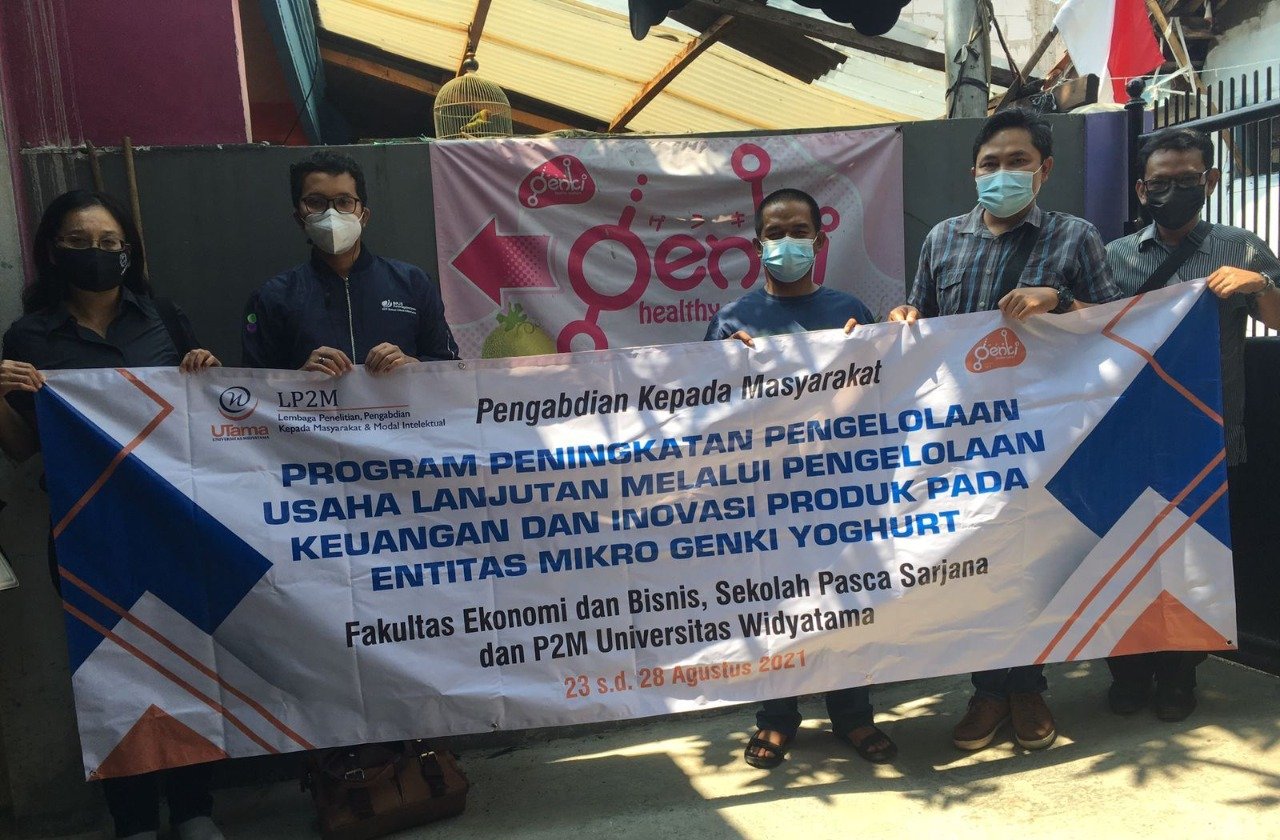
Accounting lecturers from the Faculty of Economics and Business (FEB) and the Graduate School (SPs) in collaboration with the Universitas Widyatama (UTama) Institute for Research and Community Service (LP2M) once again carried out Community Service (Abdimas) activities in the form of a program to improve business management through financial management and product innovation at the micro entity Genki Yoghurt.
The activity was carried out on August 23-28, 2021, during the PPKM policy for Java-Bali due to the COVID-19 pandemic.
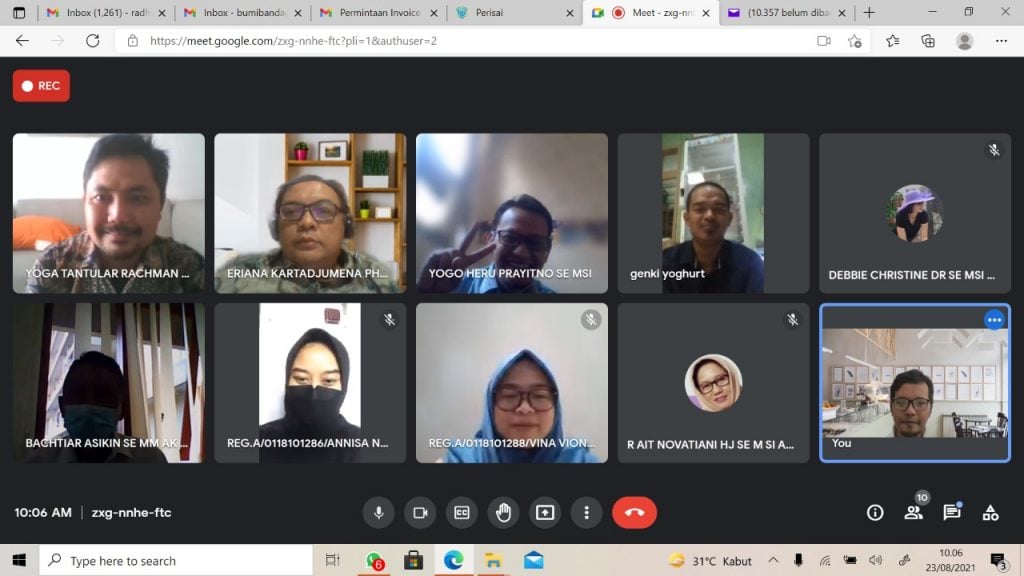
The Head of the UTama Abdimas Cluster, Eriana Kartadjumena, Ph.D, Ak, CSRS, officially opened the activity on Monday (8/23/2021) virtually through a video conference.
The event was attended by the Head of Abdimas, Yoga Tantular Rahman, M.Si., including Abdimas implementers consisting of lecturers, accounting students, and Engkos, the owner of Genki Yoghurt.
The Head of Abdimas UTama, Eriana Kartadjumena, Ph.D, Ak, CSRS, revealed that this activity was a tangible manifestation of the concern of UTama Accounting Lecturers in their efforts to maintain and advance the business potential of Micro, Small and Medium Enterprises (MSMEs) in the city of Bandung. This is especially important in facing the difficult situation caused by the ongoing COVID-19 pandemic.
According to Eriana, the classic problem faced by most MSME players today is a lack of capital, in addition to poor business transaction bookkeeping, which results in inefficient financial management.
“This has an impact on MSME players being considered unfeasible in accessing capital credit from financing institutions and banks. This condition often hinders MSMEs from developing and expanding their business scale,” said Eriana on Thursday (9/9/2021).
This condition was also confirmed by Engkos, owner of Genki Yoghurt.
According to Engkos, his business, which was established in 2005, does not yet have good transaction recording and financial management systems.
In addition, limited capital has resulted in Genki Yoghurt’s relatively small production capacity.
“This situation has been worsened by the difficult economic conditions caused by the implementation of restrictions on community activities (PPKM) since the beginning of July, which have been extended due to the COVID-19 pandemic that has been ongoing since early 2020,” said Engkos.
Genki Yoghurt is located at Jalan Sindangsari 1, Gang Mekarsari 1 No. 3, RT 03/RW 08, Antapani Wetan District, Antapani Village.
Currently, it is still able to survive amid the COVID-19 pandemic PPKM. However, due to the COVID-19 pandemic, its production has dropped by up to 80%.
Now, Genki Yogurt can only produce 80-100 liters of yogurt per month. Before the pandemic, Genki Yogurt could produce up to 500 liters per month.
To maintain the business and cover his family’s needs, due to the drastic decline in production, Engkos and his partner sought alternative income by working as online motorcycle taxi drivers.
In this Abdimas activity, accounting lecturers, as the main implementers, assisted by students, took turns visiting Genki Yogurt’s business premises to conduct training and mentoring on product management and innovation while strictly adhering to health protocols.
Each Abdimas visit was limited to three implementers, with the agenda focusing on digital financial management training, product development, and recommendations on pricing and marketing strategies for the business in the context of COVID-19.
The Head of Abdimas, Yoga Tantular Rachman, M.Si., when giving his closing remarks for the Abdimas activity on Saturday (08/28/2021), said that even though the Abdimas activity had ended, the mentoring, monitoring, and evaluation processes would continue until the recommendations for improving financial management to digital were implemented.
This includes ensuring that product innovations can be effectively implemented in the Genki Yoghurt micro-business.
It is hoped that through the Abdimas activities of the UTama Accounting Lecturers, Faculty of Economics and Business, Genki Yoghurt will be able to improve its financial management through consistent and continuous financial management digitalization and increase its marketing through product innovation, enabling it to survive the COVID-19 pandemic and PPKM restrictions.
(Source: majalahsora.com)