


It has been almost two years since we entered the COVID-19 pandemic, which began in January 2020 and continues to this day.
All aspects of the country’s economy have been affected by the pandemic. Many companies, both private and individual, have been unable to adapt to the pandemic and have gone out of business. This has not only affected the companies, but also the workers employed by them.
Based on data quoted from bps.go.id, the sector that experienced the largest decline in employment was agriculture, forestry, and fisheries (1.43 percentage points). A total of 77.91 million people (59.45 percent) worked in informal activities, down 1.02 percentage points compared to August 2020.
The percentage of part-time workers rose by 1.03 percentage points, while the percentage of underemployment fell by 1.48 percentage points compared to August 2020. There were 21.32 million people (10.32 percent of the working-age population) affected by COVID-19. This consists of unemployment due to COVID-19 (1.82 million people), not in the labor force (BAK) due to COVID-19 (700 thousand people), while not working due to COVID-19 (1.39 million people), and working population who experienced reduced working hours due to COVID-19 (17.41 million people).
As the number of unemployed people increases, so does the number of families experiencing a decline in income.
Now that the end of 2021 is just around the corner, we may agree that the past two years have been a time for us all to engage in muhasabah (self-reflection/evaluation). This is because we may have faced not only economic challenges for ourselves and our families, but also the loss of loved ones due to COVID-19.
This is one of the reasons for holding a Community Service (PKM) event with the theme “Sakinah Finance”. Held on Saturday, December 18, 2021,
The word Sakinah itself can be interpreted as a soothing or calming feeling, which comes from the inclination of the hearts of both partners. If so far we have known the word Sakinah as a complement in a series of marriage prayers, or a concept that is only attached in the context of marriage.
It is rarely seen as a concept in the realm of family finance. Yet, one of the foundational pillars that enables a family to experience peace is a family’s economic foundation that can meet all its needs.
“Sakinah Finance” is the title of a book written by the couple Luqyan Tamanni and Murniati Mukhlisin, which broadly explains the concept and details of financial management that can bring peace to our families in an Islamic manner.
This financial condition has not been a concern for all related parties, so it has become a concern for the Community Service (PKM) activities of Widyatama University (UTama) Bandung, led by Sakina Ichsani, S.E., M.M., who is also a lecturer at UTama.
This routine activity, which is conducted every semester and funded by LP2M UTama, aims to provide an explanation and overview of the importance of family financial management based on religious principles.

The event was opened by the Dean of the Faculty of Economics and Business, Dr. Hj. R. Adjeng Mariana F, S.E., M.M.
During this event, participants were given an overview of important aspects related to sharia-compliant financial management, namely Management and Planning.
Why is planning necessary? The reason why financial planning is necessary and an important part of household management is because life must be planned, every family has different dreams and aspirations, the modern world is accustomed to debt, and financial planning is part of maqashid syariah.
Then how is family financial management carried out? Family financial management with the concept of sakinah finance prioritizes basic needs that are dharuriyat in nature, then hajiyyat, and only after that tahsiniyyat. This is done by managing income, managing needs, managing dreams/wants, managing surplus/deficit, and managing contingencies. And finally, how is the financial planning process carried out?
Sharia-compliant financial management is one way to ensure that our family finances are stable so that we can meet our family’s needs. This can be done by ensuring that our family’s financial income comes from halal sources that are a blessing for our family.
Our family finances can be adjusted to the maqashid syariah (basic objectives of sharia). According to Ibnul Qayyim, there are five aspects of maqashid syariah in the category of basic needs:
a. Preservation of religion (hifdhud-din);
b. Preservation of life (hifdhul-hayah);
c. Preservation of intellect/knowledge (hifdhul-‘aql);
d. Preservation of lineage (hifdhun–nasl); and
e. Preservation of wealth (hifdhul-maal).
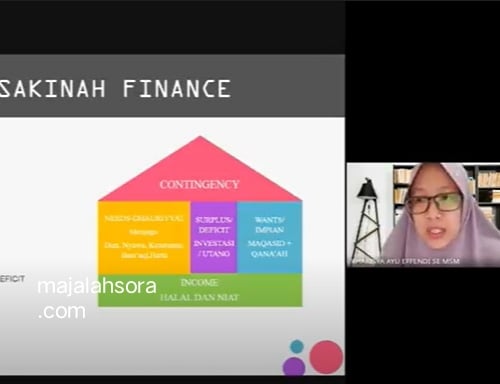
By adhering to the above principles, we can then manage and plan our family finances. This can be done by managing five things:
1. Managing Income (managing revenue).
In this category, families must ensure that their financial revenue comes from clean sources, not dubious (syubhat) or even haram sources.
2. Managing Needs (managing necessities)
In this category, we must recognize and categorize the essential needs that must be met within the family. The obligation to pay zakat is one of the necessities in an Islamic family.
3. Managing Dreams/Wants (managing desires)
Simply put, desires are things that complement our lives in terms of comfort or beauty. These things certainly have secondary/hajiyyat or tertiary (tahnsiniyyat) dimensions. In managing them, desires must pay attention to the guidelines so that they are not excessive (isyraf), wasteful, or distract us from our main duty as His servants.
4. Managing surplus/deficit
The indicator of financial success is usually the bottom line. A good bottom line will result in a surplus and vice versa. This book discusses how to manage a surplus and tips for dealing with a deficit.
5. Managing Contingency
Life often changes due to unexpected events. These events require funds that are sometimes quite large and occur when we are not ready. Emergency funds and Islamic insurance protection are two things that are recommended in dealing with this.
In this activity, the guest speaker was Kharisya, who is also a lecturer in the Bachelor of Management Study Program. She said that managing income can be summarized as follows: in managing income, we need to have the right intentions, focus on seeking what is halal and thayyib, work hard and start early in the morning, maintain good relationships, fulfill our obligations to Allah, perform muhasabah and taubat, and be grateful.
Meanwhile, managing needs in the context of maqashid syariah means regulating our consumption of all dharuriyyat and (a small portion of) hajiyyat necessities in order to maintain aspects of religion, soul, wealth, offspring, and intellect. Managing needs involves comprehensively examining the mandatory expenditures that must be considered, as well as how families should prioritize their spending to fulfill all aspects of maqashid syariah.
Managing dreams can be summarized as clearly separating between needs and wants. Wants or dreams are things we desire to complement our lives, whether to provide comfort or beautify our surroundings. Simply put, wants are all needs that have a secondary dimension (mostly hajiyyat) or a tertiary dimension (tahsiniyyat). There are no specific restrictions governing wants because each individual’s desires are very relative and vary according to the times, place of residence, or socioeconomic conditions of each person. What must be considered are perhaps the guidelines of isyraf (excess) and mubazir (wastefulness) and not neglecting our main duty as servants of Allah.
Managing surplus/deficit, as explained by Dr. Kharisya Ayu Effendi, S.E., M.S.M., in financial management, at the household or national level, the indicator of success is often the bottom line, whether in the form of profit or a surplus or balanced balance sheet. Losses or deficits are undesirable conditions. This is because when a family’s financial balance sheet is in surplus or at least balanced, the family will be able to function properly, fulfill all financial obligations, and even realize various family dreams.
Dr. Kharisya Ayu Effendi, S.E., M.S.M. concludes that managing contingencies, or unexpected events, is something we will always experience in family life, whether they happen to us or our close family. Often, these events require funds that can be quite large and occur when we are not prepared. Therefore, preparing financially is highly recommended, especially since we cannot always ask for help from family or relatives. Emergency funds and insurance protection are two things that are recommended as preparatory steps for dealing with emergency situations, such as illness, being affected by disasters, and so on.
Furthermore, in closing her presentation, Dr. Kharisya Ayu Effendi, S.E., M.S.M. said that just like a company’s annual financial statements, family finances should ideally have a final calculation to determine the family’s financial condition, whether it is in surplus or deficit. From there, we can evaluate what actions should be taken next. Whether it is a deficit or a surplus, both must be followed up properly and correctly, so that a financial balance can be created that can improve the welfare of the family itself.
(Source: majalahsora.com)