

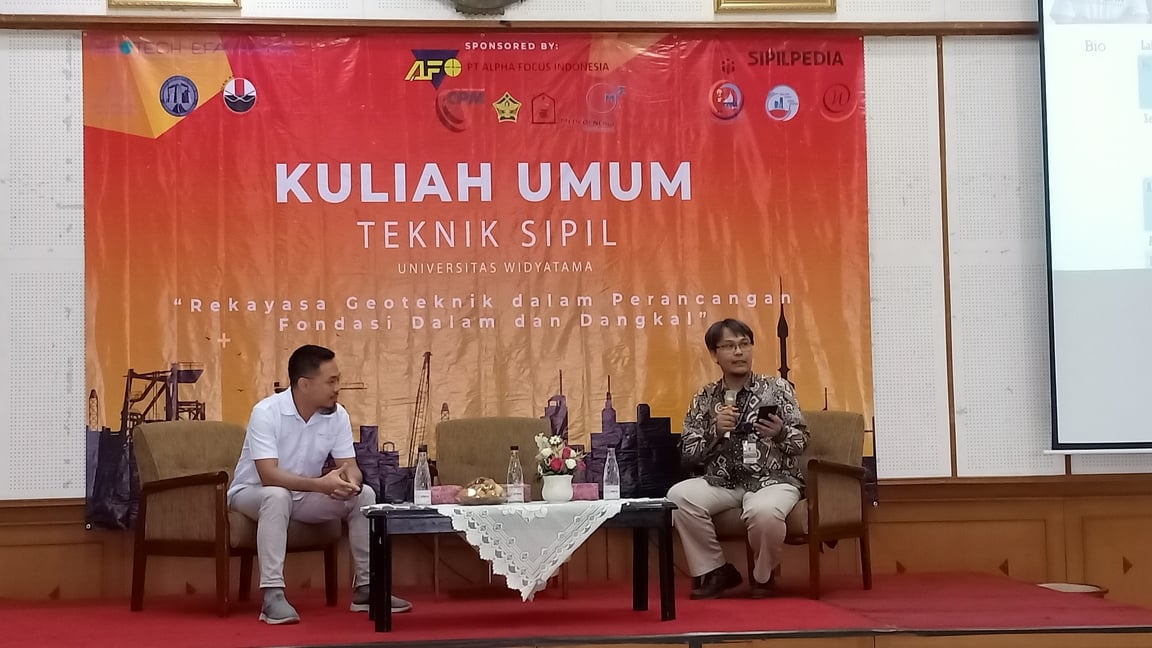
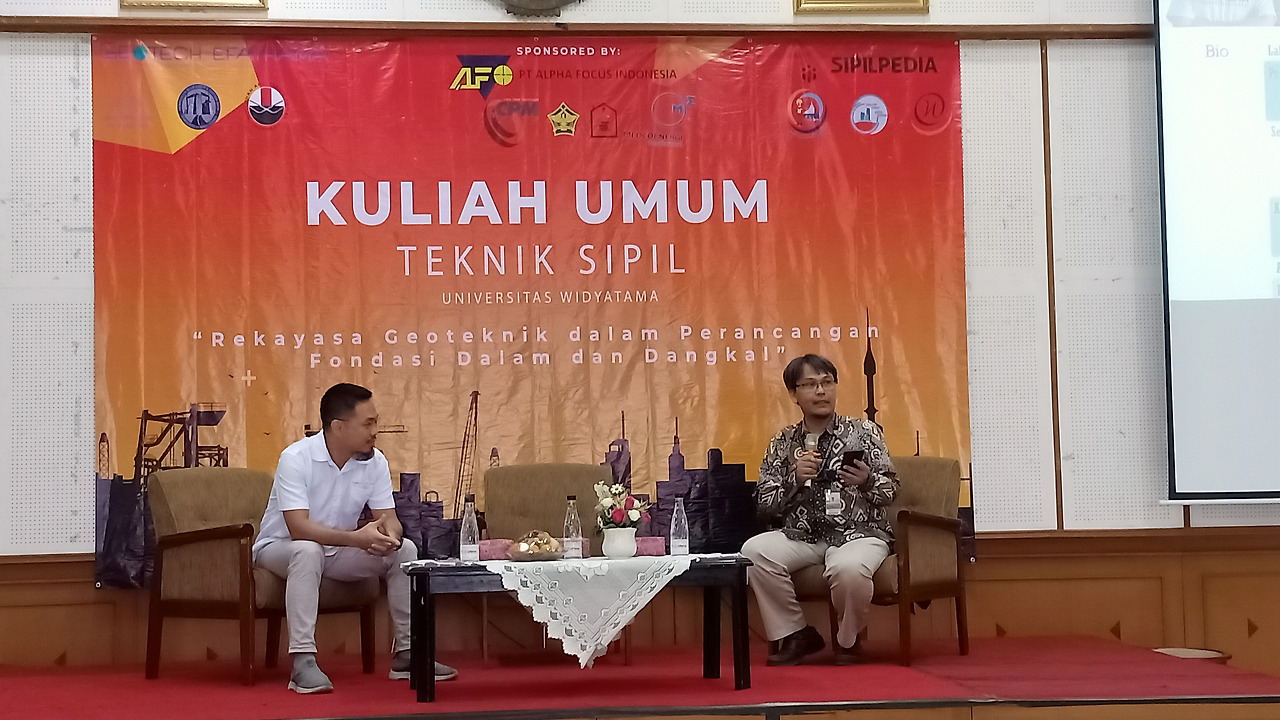
BANDUNG – Wednesday (May 17h), the Widyatama University Civil Engineering Bachelor Degree Program held a public lecture with the theme “Geotechnical Engineering in Deep and Shallow Foundation Design” in the Seminar Room on the 4th floor of Building A, Widyatama University.
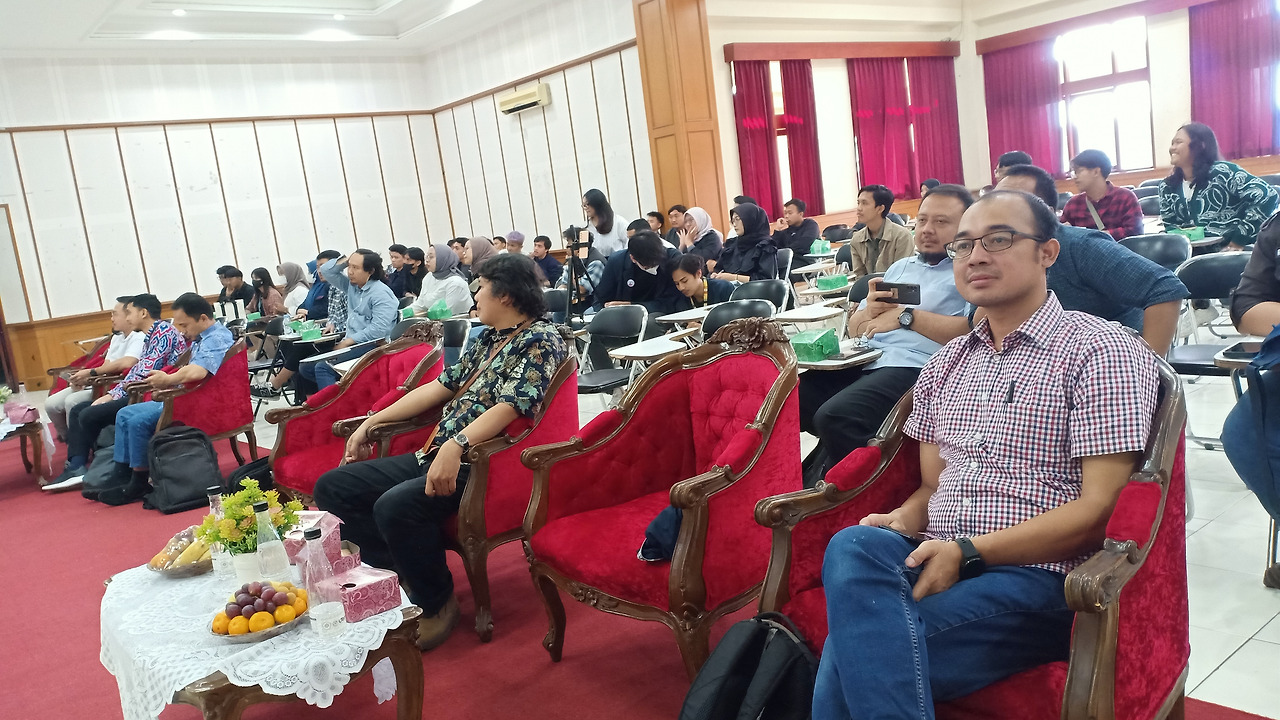
The event was attended by the Dean of the Faculty of Engineering, Dr. Didit Damur Rochman, S.T., M.T., the Head of the Civil Engineering Study Program, Asep Setiawan, S.T., M.T., with Dr. Ir. Aksan Kawanda as the speaker, who currently serves as Technical Director at Geotech Efathama, a company specializing in foundation testing and geotechnical instrumentation.
The production of concrete for highways, flyovers, and other road constructions that will be used by the public is not something that can be done carelessly. Structural requirements, safety factors, structural strength design of foundations, and foundation material requirements must refer to SNI 1726 for buildings and SNI 2833 for conventional bridges. In addition, SNI 8460-2017 is a standard related to concrete used in building construction. This standard provides requirements and rules that must be met so that the concrete is strong, safe, and of high quality.
This SNI is important to ensure that buildings have a sturdy and durable structure. By following this standard, contractors and builders can ensure that the concrete they use meets the specified requirements, thereby minimizing the risk of damage or failure to the building. One important aspect of geotechnical engineering is foundation planning. Aksan said that the art of designing a foundation is,
Foundation engineering is a combination of art and science. Don’t think of it as just a collection of formulas and graphs that are followed according to specific guidelines in design. It is important to understand how soil and structures behave, the underlying theory, and the limitations that exist when designing.
In building construction planning, geotechnical engineering can assist by performing dynamic response analysis and earthquake calculations. Dynamic response analysis can help civil engineers determine how a building will respond to shocks caused by earthquakes or strong winds. The choice of foundation type, whether pile or shallow, depends on soil conditions, building loads, and design requirements. Pile foundations are used to overcome unstable soil or low bearing capacity, while shallow foundations are suitable for more stable soil and lighter buildings.
In conclusion, geotechnics plays an important role in infrastructure planning. By understanding the characteristics of soil and rock, civil engineers can plan and design underground structures that are safe, stable, and durable against structural and environmental loads. Therefore, geotechnics is an important element in civil engineering and development planning.