

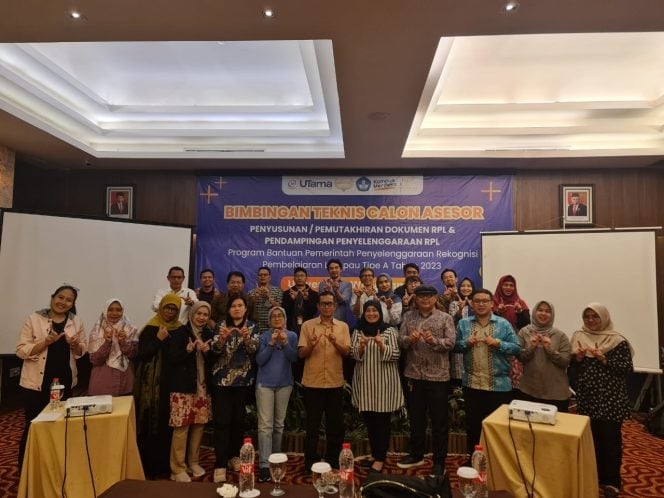
Widyatama University is one of the Higher Education Institutions receiving Government Assistance Programs, in terms of the Implementation of Type A Recognition of Prior Learning in 2023 from the Directorate of Learning and Student Affairs, Ministry of Education, Culture, Research, and Technology.
For the success of this program, Widyatama University held technical guidance activities (bimtek) for the program.
The technical guidance is aimed at prospective assessors of Prior Learning Recognition (RPL), involving a series of structured activities designed to develop the necessary knowledge, skills, and competencies.
Technical Guidance Activities, accompanied by Curriculum and Material Development: Prior to implementation, it is necessary to develop a training curriculum and materials that will cover key aspects of RPL, such as assessment methods, professional ethics, applicable standards and guidelines, and so on.
Vice Rector for Higher Education & Student Affairs Dr. R. Wedi Rusmawan Kusumah, S.E., M.Si., Ak., CA, explained that Widyatama University provides a Recognition of Prior Learning (RPL) program, which is available to various groups of individuals who may benefit from formal recognition of the learning and skills they have acquired outside of formal education.
“Technical guidance (bimtek) for prospective Recognition of Prior Learning (RPL) assessors is an important training and coaching process in the vocational education and training system,” explained Vice Rector for Higher Education & Student Affairs Dr. R. Wedi Rusmawan Kusumah, S.E., M.Si., Ak., CA, on Saturday, August 19, 2023, at the Santika Hotel, Jl. Sumatera No. 52-54, Bandung.
The activity, which began on Friday, August 18, 2023, aims to prepare prospective assessors to carry out the RPL process accurately and efficiently.
“This technical guidance is conducted through
Improving Qualifications and Competencies: Through technical guidance, prospective assessors will be taught various techniques, methods, and processes related to RPL. This will help them improve their qualifications and competencies in recognizing and assessing learning that has been experienced by someone outside of a formal educational setting,” he explained.
He added that participants will also be given an understanding of the Standards and Guidelines that prospective assessors need to understand, which have been set by the accreditation body or relevant authorities.
“Technical guidance will ensure that they understand how to apply these standards in practice.
Professional Ethics Coaching: An assessor must work with integrity, objectivity, and professionalism,” he explained.
This training will emphasize the importance of ethics in the process of assessing and recognizing prior learning.
“Harmonization of Procedures: By ensuring that all prospective assessors have a uniform understanding of RPL procedures, technical guidance helps to create uniformity in RPL practices across institutions or regions. Then Skills Development: Through technical guidance, prospective assessors will acquire practical skills in using various assessment tools and techniques relevant to the RPL process,” he explained.
The success of this technical guidance activity, as a support system for human resource development: RPL is one way to improve skills and knowledge in the workforce.
“Therefore, trained assessors will support human resource development in the community or industry.
Ensuring the Quality of RPL: Technical guidance will ensure that assessors have the knowledge and skills necessary to carry out the RPL process with high quality, so that the results are reliable and widely accepted,” he explained.
Meanwhile, the resource person, Dr. Ir. Ahmad Rifandi, from the Directorate General of Learning and Student Affairs, explained that the purpose of this technical guidance was so that the prospective assessor participants, consisting of the heads of study programs and prospective assessors from each study program that organizes RPL programs, could understand the technical aspects of implementing this program.
“Selection of Prospective Assessors: Prospective assessors may have to go through a selection process to assess their suitability for the role. This may involve an assessment of relevant experience, skills, and prior knowledge,” he explained.
Formal Training Sessions involve a series of training sessions that can take the form of workshops, seminars, or lectures.
“This training can be conducted face-to-face or online, depending on the needs and resources available.
Field Practice: Prospective assessors may be given the opportunity to conduct field practice under the supervision of experienced assessors. This helps them understand the RPL process in real-life situations,” he explained.
For Evaluation and Examinations, the team conducts regular assessments and examinations may be conducted during technical guidance to ensure that prospective assessors have achieved the required level of competence.
“This may include written tests, presentations, and practical assessments. Coaching and Mentoring: Prospective assessors may be given ongoing support from experienced mentors or coaches to help them develop their skills and knowledge,” he explained.
After the technical guidance activities, prospective assessors will receive a certificate.
“After completing technical guidance, prospective assessors may need to obtain certification from the relevant authority. This certification states that they have met the set standards and are ready to work as RPL assessors,” he explained.
In the future, there will be monitoring and ongoing support activities for assessors.
“Even after the training is complete, there may need to be ongoing monitoring and support to ensure that assessors continue to work according to the expected standards. Feedback and evaluation of these activities will be done by collecting feedback from participants and evaluators and conducting an overall program evaluation to identify areas for improvement for the next iteration of technical guidance,” concluded Dr. Ir. Ahmad Rifandi.