
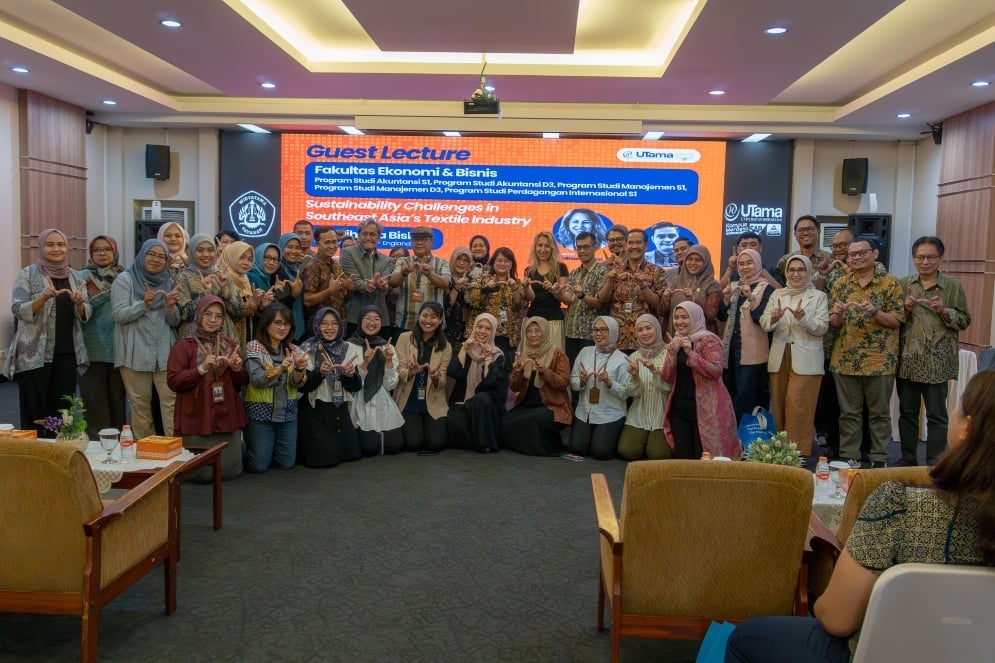
BANDUNG, WIDYATAMA – Universitas Widyatama hosted a crucial academic discussion through a Guest Lecture entitled “Sustainability Challenges in Southeast Asia’s Textile Industry.” The event, which featured Dr. Mihaela Bishop, a senior lecturer in marketing and management from the University of Exeter, UK, took place in the Seminar Room on the 6th floor of Building B at Widyatama University on Friday, May 16th, 2025. The event was attended by 100 permanent lecturers from Widyatama University as participants, with Oliver Hasan Padmanegara, S.E., M.Sc., acting as moderator, aiming to deepen understanding of the complex sustainability challenges in the textile industry in the Southeast Asian region.
Indonesian Textile Industry Challenges Highlighted
In his speech, Dr. Didit Damur Rochman, S.T., M.T., IPU., ASEAN ENG, Vice Rector for Research, Community Service, Innovation, and Cooperation at Widyatama University, provided historical context and current challenges facing the textile industry. He reminded the audience that England was the birthplace of the first industrial revolution, which centered on steam-powered textile production. “Following the 19th century, textile manufacturing began to shift to Asia, including countries such as India, Japan, and Indonesia,” said Dr. Didit. However, today, the textile industry is facing a significant decline, especially in Myanmar and Vietnam, largely due to pressure from Europe regarding the pollution generated by textile processes.
Furthermore, Dr. Didit highlighted the specific conditions in Indonesia. “Regarding change, sustainability is about the challenges, because one of them is that most of the textile industries in Indonesia are not sustainable, so they are not environmentally sustainable,” he explained. He cited the case of the Citarum River, which is heavily polluted due to textile industry waste in Bandung. In addition, external challenges such as tariff policies from the United States during the Donald Trump era have also added to the complexity of the national textile industry. Therefore, this issue has become a shared challenge that requires comprehensive solutions in terms of both management and marketing.
Guest Lecture by Dr. Mihaela Bishop: A Comprehensive Discussion on Textile Sustainability
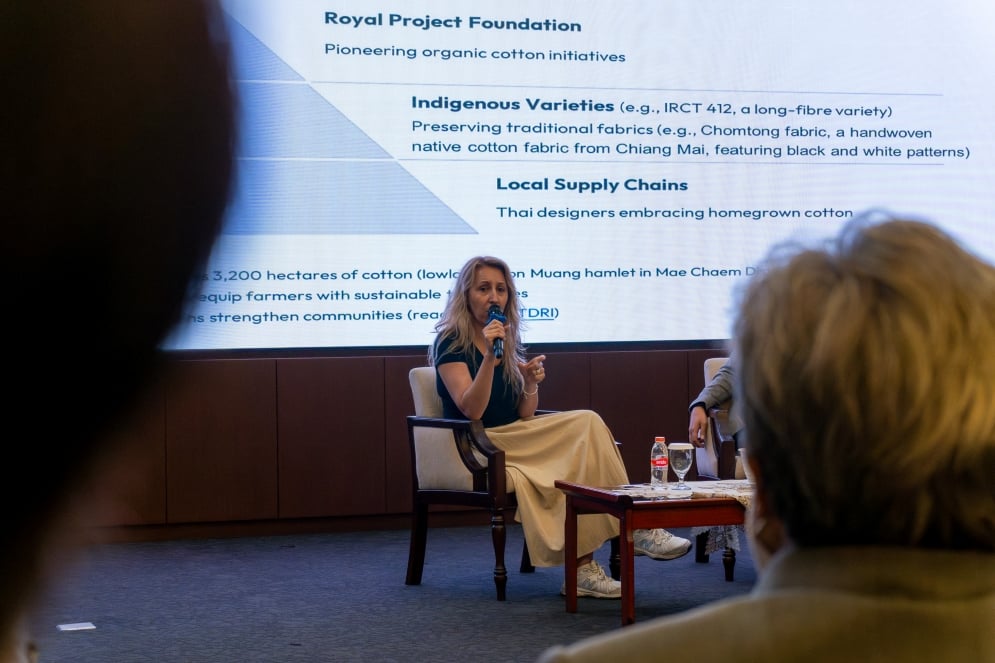
Dr. Mihaela Bishop gave a presentation at a guest lecture event themed “Sustainability Challenges in Southeast Asia’s Textile Industry.”
Dr. Mihaela Bishop’s presence as the main speaker in this Guest Lecture was expected to provide an international perspective and innovative solutions. The main focus of Dr. Bishop’s presentation was to explore the various sustainability challenges encountered by the textile industry in Southeast Asia, a region that is an important player in the global supply chain. The Widyatama University lecturers who attended enthusiastically listened to the presentation on future textile industry management and marketing strategies that focus not only on environmental aspects but also on business sustainability itself. The discussion session, moderated by Oliver Hasan Padmanegara, S.E., M.Sc., also served as an interactive forum for participants to explore relevant issues in greater depth.
Dr. Didit stressed that he importance of a holistic understanding of sustainability. “Of course, when we talk about sustainability, sustainability is not only about the environment, sustainability is not only about the environment, but sustainability of the business itself. If it is sustainable environmentally but not commercially, what is the point?” he said. He hoped that this Guest Lecture would enrich the knowledge of the lecturers, which would ultimately improve the quality of policy and teaching to students. Thus, it is hoped that new innovations and strategies will emerge to revive the Indonesian textile industry while still paying attention to the principles of sustainability.
Hopes for Increased Insight and Policy
This Guest Lecture event is seen as a strategic step by Widyatama University in improving the quality of human resources and their contribution to solving national industrial problems. By presenting reputable experts such as Dr. Mihaela Bishop, academics at Universitas Widyatama gained direct access to the latest research and best practices at the global level. The discussions that developed during the event also reflected a deep concern for the future of a sustainable textile industry, from an environmental, social, and economic perspective.
Closing his remarks, Dr. Didit expressed his hope that the knowledge gained would be put into practice. “Congratulations on the public lecture. Hopefully, we will gain a lot of knowledge here, and of course, this knowledge will lead to wisdom, our wisdom will increase, and of course, we will also be able to convey a lot of knowledge to our students. Thank you,” he concluded. The implications of this Guest Lecture are expected to extend beyond the academic realm, inspiring the creation of concrete solutions and policies that support the transformation of Indonesia’s textile industry toward more responsible and globally competitive practices.
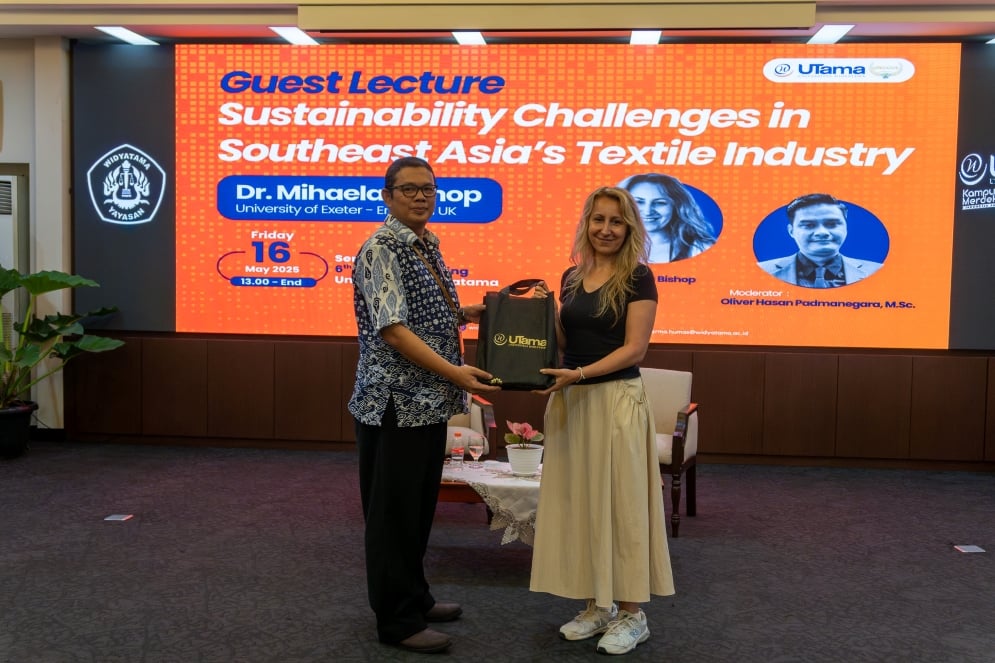
Dr. Didit Damur Rochman, S.T., M.T., IPU., ASEAN ENG, Vice Rector for Research, Community Service, Innovation, and Cooperation at Universitas Widyatama presented a souvenir to Dr. Mihaela Bishop.