
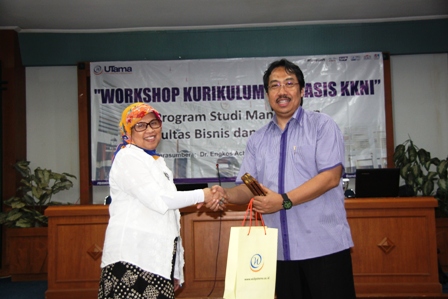
On Monday (June 8, 2015), the Faculty of Business and Management held a workshop on the Indonesian National Qualifications Framework (KKNI)-based curriculum, inviting Dr. Engkos Achmad Kuncoro, S.E., M.M. as a guest speaker. The event, which was held from 9:00 a.m. to 4:00 p.m., discussed the dissemination of the KKNI-based curriculum. KKNI is a framework for grading the qualifications and competencies of Indonesian workers that aligns, equates, and integrates the education sector with the training and work experience sectors in a scheme for recognizing work abilities that is adapted to the structure of various job sectors. KKNI embodies the quality and identity of the Indonesian nation in relation to the national education system, the national work training system, and the national learning outcomes assessment system, which Indonesia possesses to produce high-quality and productive human resources.
In his presentation, Engkos, Dean of the Faculty of Economics at Bina Nusantara University Jakarta, explained the systematization of the KKNI curriculum, which stands alone and serves as a bridge between the education and training sectors to develop high-quality, certified national human resources through formal, non-formal, informal education, job training, or work experience. Qualification levels are nationally agreed levels of learning achievement. Engkos added that the curriculum must always be updated to respond to the challenges of the times and the needs of society. The KKNI curriculum will increase the competitiveness of graduates who are specialists and have a global perspective. Specialist means that the main profile is as a teacher, while global perspective means that graduates have additional roles that can expand other fields of work.
Event committee member Anton Budi Santoso added that the KKNI is a step toward preparing graduates with a fighting spirit who can compete with graduates from abroad. “It is undeniable that currently, college graduates are not only competing with other college graduates in Indonesia. However, Indonesian university graduates are already facing competition from abroad. Therefore, it is hoped that the KKNI can prepare graduates with a fighting spirit. Thus, Widyatama University graduates have the dynamic competencies to compete in welcoming the ASEAN Economic Community (AEC 2015),” he concluded. *mktg